
This course provides a comprehensive understanding of the fundamental principles of mechanics, elasticity, viscosity, heat transfer, and thermodynamics. It covers force, work, power, energy, elasticity of solids, fluid flow, thermal conductivity, convection, radiation, and the laws of thermodynamics. Students also study important concepts such as Newton's laws, gravitational force, Poiseuille's equation, Bernoulli's theorem, heat engines, Carnot cycle, and entropy. The course combines theoretical concepts with practical applications and experimental methods, enabling students to analyze physical phenomena, solve numerical problems, and understand engineering and real-life applications related to mechanics, properties of matter, and thermal physics.
- Teacher: Arockiajency Physics
- Teacher: Mrs.A.Hemalatha Physics
- Teacher: S.Mariasteffi Physics
- Teacher: sherin Zoo
This course introduces the fundamental properties of matter, including the elasticity of solids, flow properties of fluids, surface tension of liquids, sound waves, ultrasonics, and building acoustics. Students learn the principles of Hooke's law, elastic constants, viscosity, surface tension, simple harmonic motion, resonance, ultrasonic wave generation and detection, and acoustics of buildings. The course also covers important experimental methods for determining material properties such as Young's modulus, rigidity modulus, viscosity, and surface tension. Overall, it helps students understand the physical behavior of matter and its practical applications in engineering, industry, and everyday life.
- Teacher: Dr.A Juliet Christina Phy
- Teacher: Arockiajency Physics
- Teacher: Mrs.A.Hemalatha Physics
- Teacher: sherin Zoo
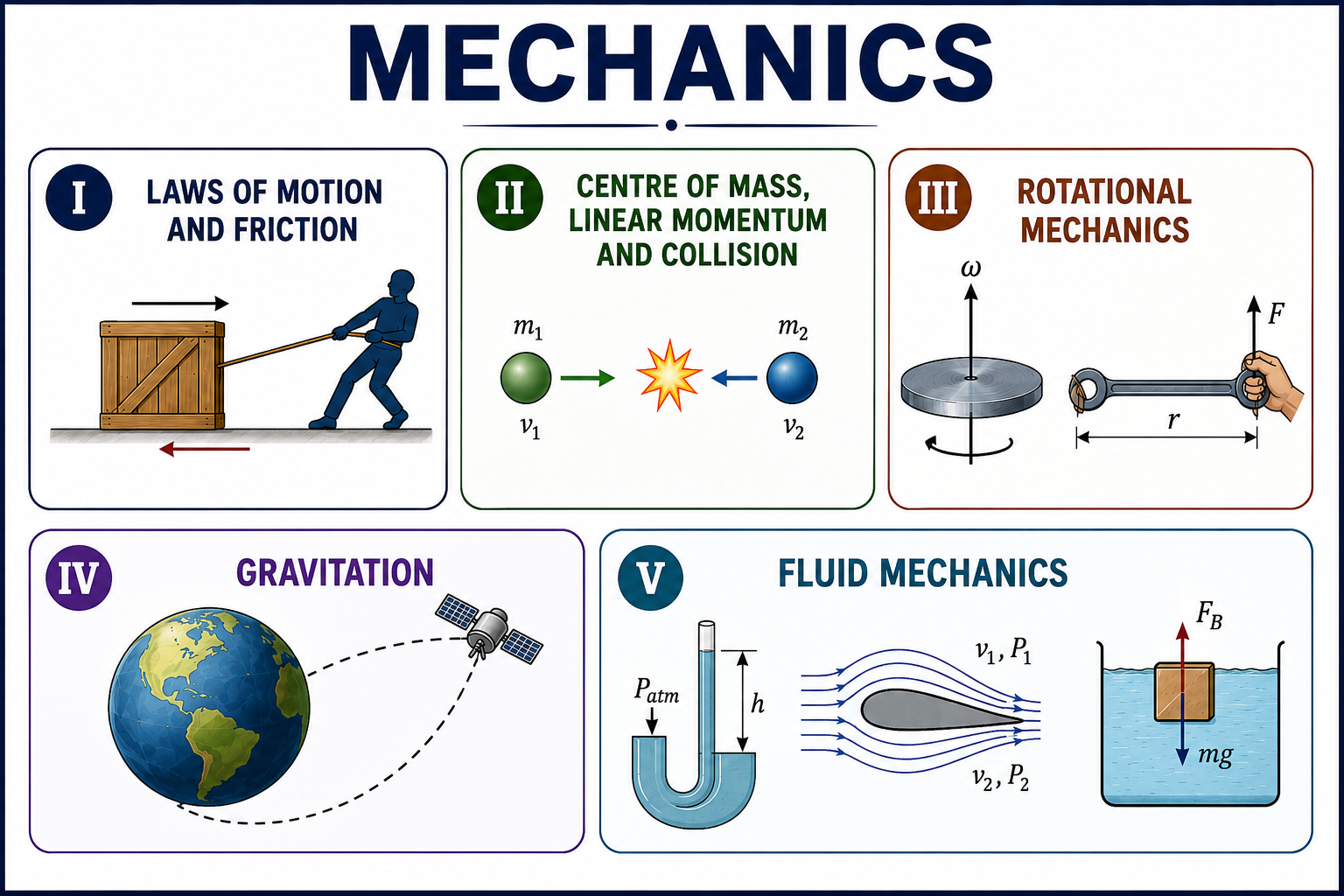
Mechanics is a first-semester physics course that introduces the fundamental principles governing the motion of objects, forces, energy, momentum, gravitation, and fluid behavior. The course begins with Newton's laws of motion, inertia, pseudo forces, and friction, including static and kinetic friction and methods for measuring the coefficient of friction. It then covers the concepts of centre of mass, conservation of linear momentum, rocket propulsion, elastic and inelastic collisions, impulse, and coefficient of restitution.
The course also explores rotational mechanics, including torque, angular momentum, rotational equilibrium, rotational kinetic energy, and the calculation of moment of inertia for common bodies. In gravitation, students study the universal law of gravitation, gravitational potential and field, variation of gravitational acceleration, satellite motion, escape velocity, black holes, and gravitational binding energy. The final unit focuses on fluid mechanics, covering pressure, Pascal's law, Archimedes' principle, fluid flow, the continuity equation, Bernoulli's equation, and their practical applications.
Overall, the course develops a strong foundation in classical mechanics and equips students with the skills to analyze physical systems and solve real-world problems using fundamental mechanical principles.
- Teacher: Arockiajency Physics
- Teacher: Dr. P. Evangelin Teresa Physics
- Teacher: sherin Zoo