
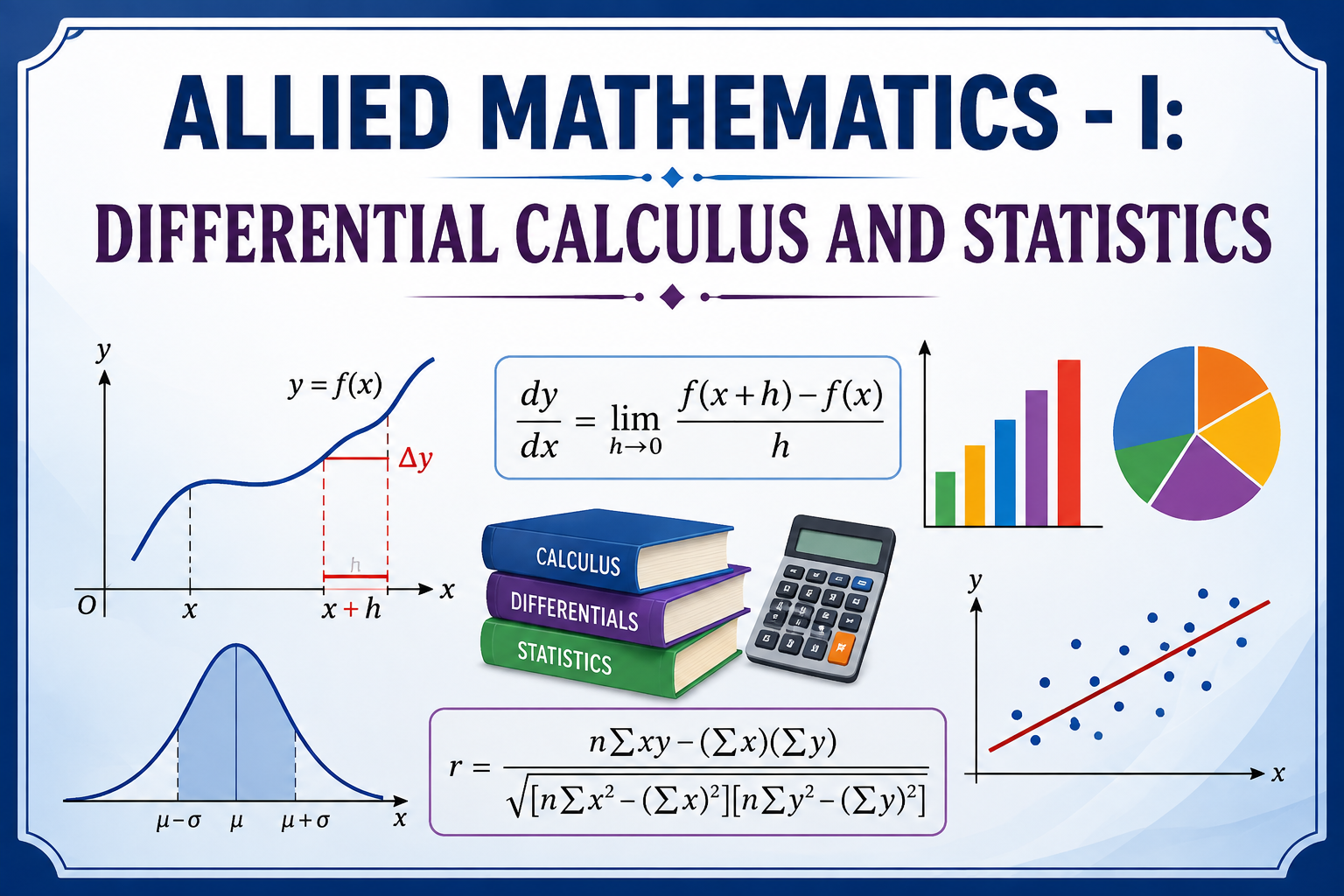
Differential Calculus and Statistics introduces the fundamental concepts and techniques of differential calculus and their applications. It covers limits, continuity, differentiation, successive differentiation, and applications of derivatives. The course also provides an introduction to statistical methods, including measures of central tendency, dispersion, correlation, and regression. It equips students with essential mathematical and statistical skills for solving problems in various disciplines.
- Teacher: Arockiajency Physics
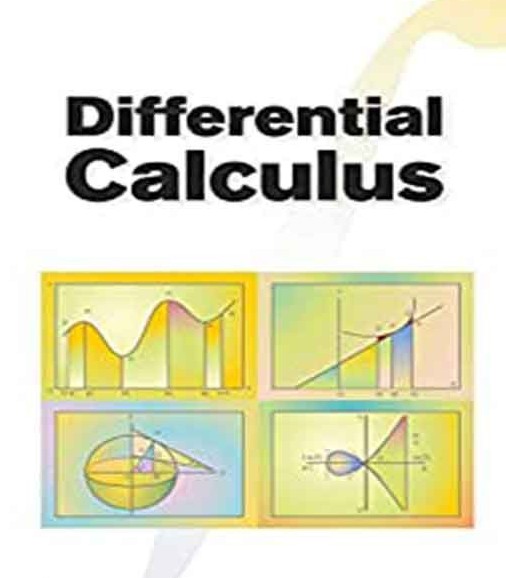
Differential Calculus is a fundamental branch of mathematics that deals with the study of rates of change and slopes of curves. The course introduces students to the concepts of limits, continuity, differentiation, and their applications. It develops analytical thinking and problem-solving skills through the study of techniques of differentiation, implicit differentiation, parametric differentiation, higher-order derivatives, curvature, pedal equations, and applications of derivatives in science, engineering, economics, and optimization problems. The course lays a strong foundation for advanced studies in mathematics and its interdisciplinary applications.
- Teacher: Dr.D.Selvi Mathematics
- Teacher: Arockiajency Physics
Algebraic Equations and Series Analysis introduces students to the theory and techniques for solving algebraic equations and evaluating mathematical series. The course covers relationships between roots and coefficients, transformations of equations, and numerical methods for finding roots. It also develops a strong understanding of binomial, exponential, and logarithmic series along with their applications. Students learn approximation techniques, summation methods, and the use of series in solving mathematical problems. Overall, the course strengthens analytical thinking, computational skills, and problem-solving abilities required for higher studies and research in mathematics.
- Teacher: Arockiajency Physics
- Teacher: santhi pk